
Special Inspection Services for Texas Construction Projects
Quartet Engineers provides qualified field inspection and testing support that documents whether specified construction work is performed in accordance with approved plans, specifications and applicable requirements.

What we offer
Service examples
Reinforcing steel placement observation.
Concrete placement and testing coordination.
Masonry and grout observation/testing.
Welding and bolting inspection where current qualifications and scope apply.
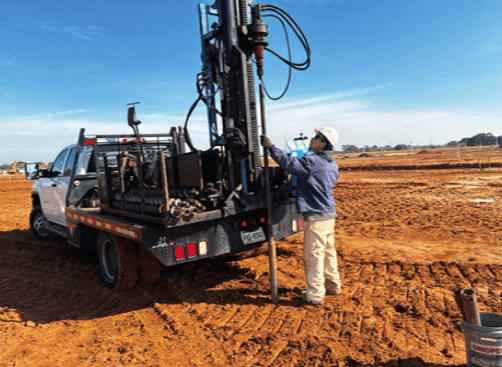
Earthwork, compaction and subgrade observation.
Daily documentation, nonconformance communication and report coordination.
Proposal inputs
Approved plans/specifications and statement of special inspections.
Jurisdiction and project address.
Construction schedule and notification requirements.
Required certifications and report distribution.
Anticipated inspection frequency and duration.
FAQ
Special Inspections FAQs — IBC Chapter 17 in Houston and Texas
What owners, GCs, and design teams ask about special inspections: who hires the inspector, what it costs, how the City of Houston process works, and what stands between you and a certificate of occupancy.
Yes, and it is usually the efficient choice. A firm already providing geotechnical engineering or construction materials testing knows the subsurface data and the project team, and can bundle inspection trips with routine testing. Quartet Engineers provides geotechnical, CMT, and special inspection services together, which reduces mobilizations and keeps one set of reports flowing to the design team and the city.
Much of the Houston area sits on expansive clay that swells and shrinks with moisture, and the Texas Gulf Coast adds shallow groundwater to the mix. Verifying bearing strata, fill compaction, and pier founding depths is how a design assumption becomes a real, performing foundation. Soils-related special inspections are where local geotechnical knowledge pays for itself many times over.
Continuous inspection means the inspector observes the work the entire time it is performed — required for activities like structural welding or pier concrete placement. Periodic inspection means the inspector checks at intervals appropriate to the task, such as verifying reinforcement before a pour. Your statement of special inspections assigns one of the two to each line item, and that assignment drives inspection cost.
No. City inspectors verify code compliance at defined milestones on behalf of the jurisdiction. Special inspectors are hired by the owner to continuously or periodically verify specific structural work — soils, concrete, masonry, steel, deep foundations — against the approved documents. Both are required; one never substitutes for the other. Think of special inspections as the technical depth behind the city's milestone checks.
The inspector documents the discrepancy and notifies the contractor for correction. If the issue is not resolved, it is reported to the design professional and the building official. Failed work is corrected, re-inspected, and closed out in the reports — it does not simply disappear. Catching a compaction or reinforcement problem before concrete covers it is exactly the value the process exists to deliver.
A statement of special inspections is a design-phase document listing every required special inspection for the project: the materials and activities covered, whether inspection is continuous or periodic, and the parties responsible. It is submitted with the permit documents and becomes the roadmap for field inspection throughout construction. A complete, accurate statement is the single best defense against inspection surprises and change orders.
Plan on 24 to 48 hours for routine scheduling, and confirm the exact protocol at your preconstruction meeting. Firms with Houston-based field crews can often accommodate next-day or even same-day requests when weather shifts a pour. Build inspector notification into your contractor's three-week look-ahead schedule, and most scheduling friction disappears entirely.
Special inspections run the full length of structural construction, because they track the work rather than the calendar. Individual inspections are short — a compaction check or a pre-pour reinforcement review typically takes part of a day. What matters is coverage at hold points: pours, pier drilling, steel erection. With proper notice, inspections happen inside your existing schedule and add essentially zero days to it.
The owner pays. IBC Section 1704.2 requires the owner, or the design professional acting as the owner's agent, to employ the special inspector. This preserves independence: the inspector should not answer to the contractor whose work is being verified. Budget special inspections as an owner's soft cost alongside design fees, and engage the firm before construction starts so the scope is priced accurately.
Cost scales with your inspection scope, not your square footage. The main drivers are the number of site trips, continuous versus periodic inspection requirements, and laboratory testing volume. A project with many small pours costs more to inspect than one with a few large pours. Send your statement of special inspections and structural drawings to a firm like Quartet Engineers for a line-item proposal rather than budgeting from a rule of thumb.
Ready to start?