
Geotechnical Investigations & Reports for Texas Projects.
Quartet Engineers plans and performs subsurface exploration, soil boring services, laboratory testing and engineering analyses for commercial, residential, municipal, industrial and infrastructure projects in Greater Houston, Dallas-Fort Worth and throughout Texas. Deliverables translate feld and laboratory data into practical foundation, pavement, earthwork and construction recommendations.
Overview
Our skilled team offers cost-effective solutions across various projects and markets
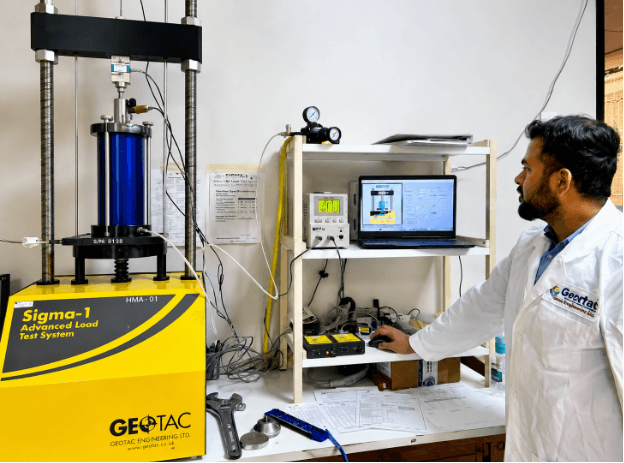
Quartet Engineers' geotechnical engineering services are focused on a value engineering approach, providing value during all phases of a project, from preliminary engineering through completion of the building process. Our expertise allows us to provide geotechnical design recommendations that minimize construction costs, reduce construction time, and effectively manage construction risks. We use advanced software packages for analysis of slope stability and retaining walls, foundations, and pavement designs, which equip our engineers with the most advanced tools available to predict structural performance accurately and provide prudent and practical recommendation.
What we offer
Our geotechnical services include a broad range of offerings
Subsurface Exploration & Soil Boring Services
Geotechnical investigation and soil investigation planning.
Soil boring services and hollow stem auger drilling where appropriate.
Sampling, feld logging and groundwater observations.
Subsurface exploration for commercial, infrastructure, subdivision and industrial projects.
Environmental drilling or monitoring-well coordination when part of an approved scope.
Engineering Analysis & Design Recommendations
Geotechnical report preparation.
Foundation design recommendations for shallow/deep foundations, slabs, tank pads and building pads.
Bearing capacity analysis and settlement analysis.
Expansive-clay and moisture-movement evaluation.
Pavement design for parking, roadways, drives and industrial access.
Slope stability assessment and geotechnical retaining-wall support.
FAQ
Geotechnical Engineering & Testing — Frequently Asked Questions
Straight answers to the questions Houston developers, general contractors, and municipal engineers actually ask about soil investigations, borings, geotechnical reports, and foundation recommendations across Texas.
Your structural engineer and civil engineer should review it in full, and your GC should see the earthwork, select fill, and groundwater sections before pricing. As the developer, read the five key numbers and the limitations page yourself. A short call between the geotechnical engineer and your design team resolves most questions quickly. Schema note for web team: publish these questions with FAQPage JSON-LD schema (each question as a Question entity, each paragraph as its acceptedAnswer) on the same URL as the article.
Usually not for design. Soil conditions can change across a property line, and the report's limitations section restricts its use to the studied site and structure. A neighboring report is useful for early feasibility thinking, but permitting, lenders, and your engineer of record will expect a site-specific, sealed report.
Shallow groundwater complicates excavation and drilled-pier construction: boreholes can cave, casing or slurry may be needed, and dewatering can enter the budget. It also affects utility trenches and below-grade structures. Check both the during-drilling and after-drilling readings, and remember Gulf Coast water levels swing seasonally — one dry reading is not a guarantee.
Select fill is imported soil with a controlled, low plasticity index used beneath slabs and pavements to replace or cap expansive clay. Reports specify its PI range, lift thickness, and compaction — often around 95% of standard Proctor density. It reduces movement at the surface and gives concrete a predictable base.
Much of Harris County sits on expansive clay that swells and shrinks with seasonal moisture. Drilled piers transfer building loads below that active zone into more stable soil, so the structure rides out surface movement. Reports typically state a minimum pier depth — commonly 10 feet or more — plus diameter and reinforcement guidance.
Allowable bearing capacity is the pressure the soil can safely support under a footing or slab, already reduced by a factor of safety. It is often stated in ksf (kips per square foot). Your structural engineer uses it to size foundations — lower capacity means bigger footings, more piers, or deeper elements.
Atterberg limits describe how a clay changes behavior as it gets wetter: the plastic limit and liquid limit bracket that behavior, and their difference is the plasticity index (PI). A PI above roughly 20 flags expansive, movement-prone clay. On the Texas Gulf Coast, PI is often the single most consequential lab number in the report.
PVR, or potential vertical rise, is an estimate of how many inches expansive clay could swell beneath a slab, commonly calculated using TxDOT method Tex-124-E. On Houston-area sites, values of 1 inch to 4 inches are common. Higher PVR pushes designs toward stiffened slabs, moisture conditioning, or drilled piers.
A boring log is a depth-by-depth record of one soil boring: soil descriptions, sample types, moisture contents, blow counts (N-values), and observed groundwater. Read it top to bottom like a timeline of the ground. Comparing logs across the site shows whether conditions are uniform or variable — variability is a hidden cost driver.
Five values drive most foundation cost on Gulf Coast projects: plasticity index (how expansive the clay is), PVR (predicted heave in inches), allowable bearing capacity, recommended pier or footing depth, and groundwater depth. Pull those five onto one page and you can hold a productive conversation with your structural engineer immediately.
Ready to start?
Your project success starts here.
Tell us about your site and project goals — our geotechnical team will scope an investigation program sized exactly to what your project needs.