
Construction Materials Testing in Houston & Across Texas
Quartet Engineers provides construction materials testing, feld observation, special inspections and laboratory coordination for earthwork, concrete, asphalt, pavement, masonry, reinforcing steel and related construction. Houston-based teams support Greater Houston, Dallas-Fort Worth and projects throughout Texas.
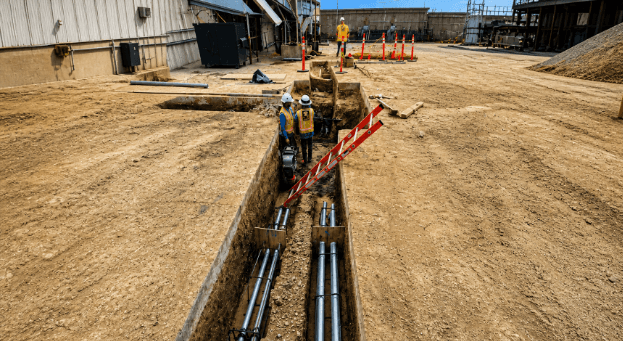
Overview
Our skilled team offers cost-effective solutions across various projects and markets.
Quartet Engineers offers a wide range of material engineering and testing services for sampling, testing, and documenting the quality of construction materials for projects of all types and sizes. Our material testing team is comprised of experienced engineers and certified technicians who provide expertise to ensure reliable and accurate material testing results. We promptly identify issues in any phase of the project, conforming results with reliable material testing, and work with the project team to provide alternative solutions
What we offer
Field testing and observations
Construction observation and daily documentation.
Density and moisture testing.
Compaction testing and Proctor testing.
Proof-rolling observation.
Concrete testing: slump, air, temperature, cylinders, beams and cores as applicable.
Asphalt/pavement and aggregate testing.
Lime treatment and depth checks.
Reinforcing steel, welding, bolting, masonry and grout where qualifed.
Special inspection services and QA/QC testing.
What is proof-rolling?
Proof-rolling uses a loaded vehicle to evaluate prepared subgrade and identify yielding, rutting or unstable areas before pavement or fill placement. It supplements - rather than replaces - density testing and engineering observation.
What is compaction testing?
Compaction testing compares in-place dry density and moisture to the laboratory moisture-density relationship specified for the material. Results document whether fill, subgrade or trench backfill meets requirements.
Proposal inputs
Send plans/specifications, site address, construction schedule, anticipated earthwork/pour dates, requested methods, reporting contacts and any statement of special inspections.
FAQ
Construction Materials Testing FAQs — Houston CMT & Materials Lab
Straight answers to the questions Houston owners, GCs, and engineers actually ask about construction materials testing, compaction, concrete breaks, and our A2LA-accredited in-house lab.
Plan on 24 to 48 hours for routine scheduling; Houston-based CMT firms with local dispatch can often cover next-day or same-day requests when weather moves a pour. Build testing notification into the contractor's three-week look-ahead schedule. Concrete placed without sampling has no acceptance record, and the engineer can require expensive coring later.
Most Houston projects budget construction materials testing at roughly 0.5% to 1% of hard construction cost, billed as technician hours plus per-test lab fees. Spec-driven test frequency, trip count, and pour schedule drive the total more than the rate sheet. Send your spec and drawings to the lab for a line-item proposal rather than budgeting from a rule of thumb.
A2LA accredits laboratories to ISO/IEC 17025, the international standard for testing competence. Auditors independently verify equipment calibration, technician proficiency, and procedures for each test method on the lab's scope. For owners and agencies, accreditation means the numbers are defensible: with building officials, with lenders, and in court if a dispute ever reaches one.
The testing firm reports the low break to the contractor and engineer of record. Typical next steps: check companion cylinders, hold 56-day breaks, core the in-place concrete, or perform a structural analysis of the affected member. Removal is the last resort. The engineer of record, not the testing lab, decides the remedy.
Much of Harris County sits on high-plasticity clay that swells when wet and shrinks when dry. That seasonal movement can lift and drop slabs unevenly, cracking foundations and finishes. Proper moisture conditioning, compaction verified by density testing, and foundation designs matched to the geotechnical report are the standard defenses on Gulf Coast sites.
Yes. TxDOT work requires testing to TxDOT test procedures, performed by qualified labs and technicians with the appropriate certifications, and many items must be tested by labs on TxDOT's approved list. City of Houston projects similarly reference city standard specifications with defined testing responsibilities. Verify lab eligibility before bid day, not after award.
Special inspections are code-mandated verifications of critical structural work: concrete, reinforcing steel, deep foundations, engineered fill, structural steel connections, and masonry, among others. The building official enforces them through the permit. The structural drawings carry a schedule of required inspections, and a final special inspection report is generally required before a certificate of occupancy.
It means the field density of compacted soil equals at least 95% of the maximum dry density established by a laboratory Proctor test on that same material. It is not 95% of "solid." A nuclear density gauge or drive sleeve measures the in-place value; the lab curve provides the target and optimum moisture range.
Rule of thumb: about 65% to 75% of the specified 28-day strength. A 4,000 psi mix should typically break near 2,600 to 3,000 psi at 7 days. Mix designs, admixtures, and hot Gulf Coast curing temperatures shift the curve, so 7-day results are an early-warning indicator, not an acceptance criterion.
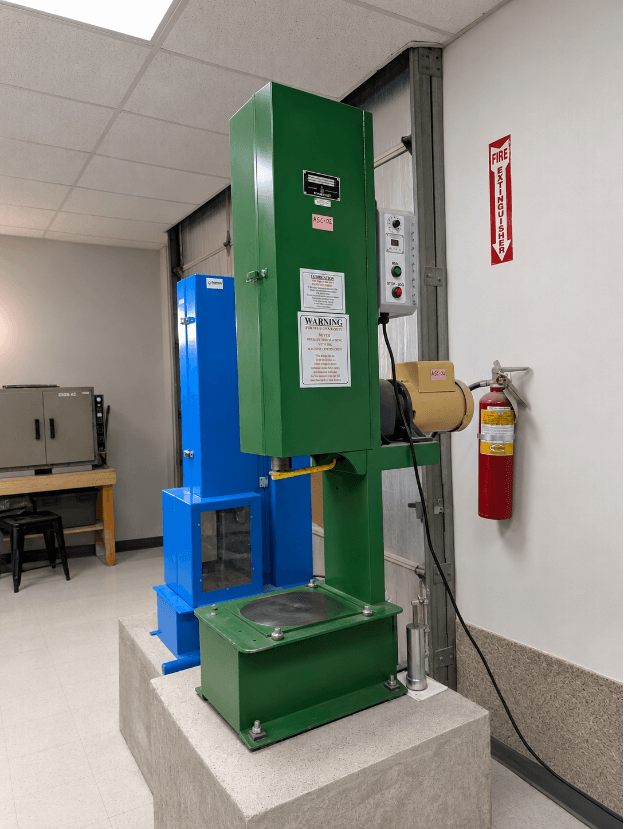
A concrete break test crushes a cylinder cast from the actual concrete placed on your project. Technicians sample the mix at the truck, cast cylinders, cure them, and load them to failure in a calibrated press at 7 and 28 days. The result, in psi, is the legal record of whether the pour met design strength.
Ready to start?
Reliable testing for every construction project.
From pre-construction submittals through final acceptance testing, our CMET team provides the quality documentation your project demands.